Special Series: The -Ism Storytellers, Queer Elders
Stories bring people together in shared humanity. Personal stories can uplift, move and connect. In 2025, Dmae Lo Roberts embarked on a statewide storytelling experience focusing on personal stories from both artists and community members. These stories are a form of living oral history. The -Ism Storytellers Project was launched as a project of MediaRites with Dmae as the project director. Six storytelling events — in Astoria, Eugene, The Dalles and three in Portland — were held with the theme of “Courage, Grace and Grit.” What began as a storytelling event has evolved into a diverse oral history gathering project. Each event was audio recorded (some filmed.) This collection of audio histories is the heart of this special series.
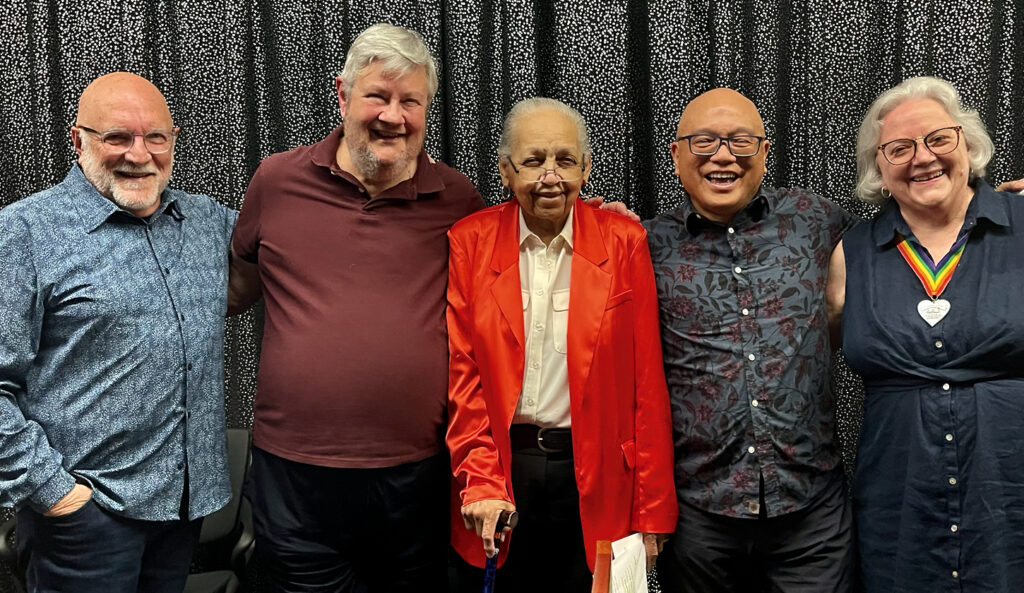
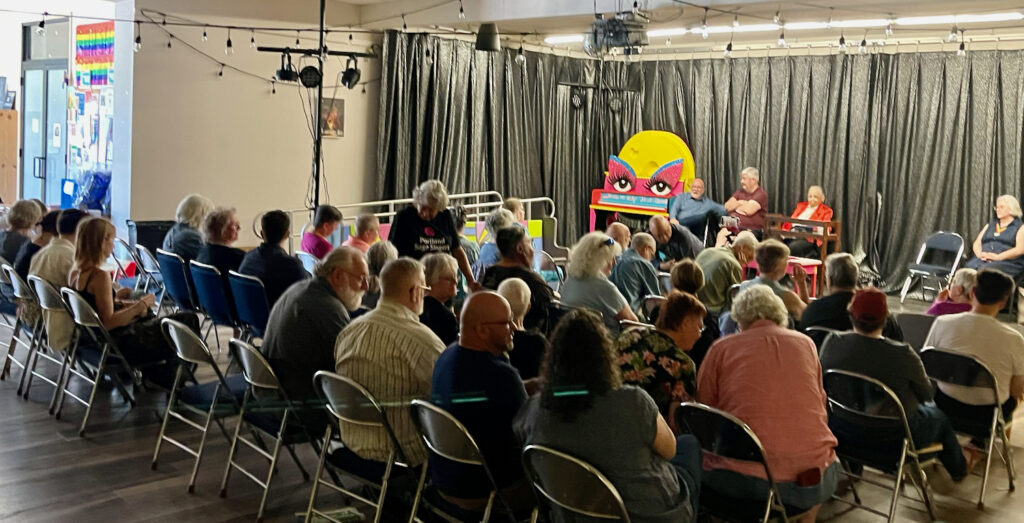
During Pride Month, we celebrate Queer Elders with this episode of The -Ism Storytellers. For each event, Dmae asks someone within specific communities to act as the host and curator. The host/curator for this event was veteran playwright, poet and author Sandra de Helen who asked specific people she’s known, some for decades, to tell a 10-minute story on the theme. She chose Tim Seelig, choir director of Sage Singers, Reid Vanderburgh, singer with Portland Gay Men’s Chorus, Kathleen Saadat, poet and acclaimed activist (she organized the first Pride march in Portland), and Horatio Hung-Yan Law, noted veteran visual artist. All are veteran artists in their fields. This event was held in August 2025 to a packed house at the Q Center in Portland.
Hear the first in the The -Ism Storytellers series on mixed race.
Excerpt from Sandra de Helen’s story about the grit to keep writing:
“In my twenties, I had several poems published. Won a few more contests.Feeling proud of myself, I signed up for a creative writing class at the University of Alaska in Anchorage. Before the semester was over, my professor, Tom Sexton, told me I’d never be a poet—because I didn’t write like a man. He pointed to a woman in our class who had nine children, and said she could write like a man. So because of his harsh words—and my own insecurity—I stopped writing poetry. That was 1970. It took courage to keep writing through rejection and silence.It took grit to write when no one was asking for it. Grace? That came later.”
Excerpt from Horatio Hung-Yan Law about discovering art during the AIDS pandemic:
“For gay men coming out during that time, liberation came with a terrible price amid the joy of discovering one’s gay identity and sexuality. I was surprised. It was also tainted with uncertainty and prospect of horrible sufferings and death. In the middle of this whirlpool of loss and fear, mystery and shame, one could easily get lost about your goals in life or questioned your reason to live. And then there was this question about my own mortality. It dawned on me that if I were at all serious about this art thing, I better start doing something about it. That’s when I realized I need to listen to my heart. And follow that whisper. It is said that art is about living. If I were an artist, I would explore every part of myself.”
Excerpt from Kathleen Saadat’s story about climbing a rockwall:
“What, what does it mean? The grace, the goodwill, the kindness, the empathy, the caring, all of which helped me up the rock. They pushed me up the rock, they pulled me up the rock. It was the grace. Not what you say before dinner, but it was that feeling of having a group of people that cared about you, want you to succeed.”
Excerpt from Reid Vanderburgh about being trans in his younger days:
“I understand now with several decades of hindsight that the commonality between me and my partner is we were both trans. But the difference is my partner had always had this male persona inside and knew it, just didn’t know you could do anything about it. And then one day my partner saw an article random in a magazine about a trans man and thought. Oh my God. You can transition that direction. I had no idea. And came home and said to me, I’ve always felt like a man inside, and if I had the money, I’d have an operation tomorrow.”
Excerpt from Tim Seelig about aging and recently deciding to skydive:
“Being old takes courage. It takes courage to get out of the house. It takes courage to put on our clothes. It takes courage not to wear elastic pants, just on special occasions. A few weeks ago, four weeks ago, I faced yet another little ladder and I looked at it and I thought, okay, here we go. And I climbed up with the help of some people got in this little metal tube and it took off and went to 14,500 feet and I jumped. Wow. The landing was beautiful and I did not say I want to do it again. I think about the grit. It’s taken all of us to get here.”
This episode featured music from the Portland Sage Singers from artistic director Tim Seelig.
- “The -Ism Storytellers Project” is presented with support from the Ronni S. Lacroute Fund through the Oregon Community Foundation and the Portland Arts and Culture Arts Access Fund. This oral history audio program is made possible in part by the Oregon Arts Commission, the National Endowment for the Arts, and the America 250 Oregon Commission.
- This is a co-production of MediaRites and Oregon ArtsWatch. Find these stories and more at Oregon ArtsWatch at orartswatch.org.
- MediaRites is an award-winning nonprofit production organization in Portland, Oregon, dedicated to telling the stories of diverse cultures and giving voice to the unheard through the arts, education and media projects. More info: https://mediarites.org/
Podcast: Play in new window | Download

